Your first ultra: how to prepare for a 50K and beyond
Running your first ultramarathon? How to choose a race, train by time instead of miles, practice fueling and power hiking, and pick the gear you really need.
Reading time: 11 minLast updated: November 3, 2026
Anything longer than the 26.2 miles (42.195 km) of a marathon is an ultra. That ranges from a 50K on the road to 100-mile mountain trails. Most runners choose a 50K for their first ultra. It's the closest to a marathon in effort: you're out there longer, but you don't run through the night, and you can keep running for most of it.
A first ultra makes the most sense if you've already finished a marathon, or if you've been running consistently for months with long runs of two hours or more. If you're just getting started, choose a marathon first; our marathon training plan shows what that buildup looks like. For a 100K or 100-mile race, a solid base matters even more: plan on a weekly volume that has been above 45 km28 mi to 55 km34.2 mi for a while, or on a marathon you've already run.
Two 50K races can be completely different. When you choose, look at four things:
Road or trail. An ultra on the road or on wide paths runs like a long marathon, at a fairly steady pace. On a trail, the surface and the climbs keep changing: your pace says little there, your effort says everything.Elevation gain. The total climb over the race (often called D+) determines how hard a course is. A common rule of thumb from ITRA, the international trail running association: 100 meters (about 330 feet) of climbing costs about as much as 1 extra kilometer. A 50K trail race with 2,500 meters (about 8,200 feet) of climbing therefore feels more like 75 kilometers.Cutoff time. Many ultras have a time limit for the finish and sometimes cutoffs at aid stations along the way. For your first one, choose a race with generous cutoffs so you don't have to chase the clock.Aid stations and mandatory gear. How often is there an aid station, and what do they serve? What do you have to carry yourself? It's all in the race rules, and it shapes what you need to practice in training.
These examples show how big the differences are. They're calculated for a runner who currently runs a 4-hour marathon, using the same prediction as our personal training plan. The progress you'll still make during your plan isn't included.
Race
Expected finish time (h:mm)
50K on the road
4:50 to 5:05
50K trail, with 1,000 m (3,300 ft) of climbing
5:55 to 6:15
50K trail, with 2,500 m (8,200 ft) of climbing
7:45 to 8:20
100K on the road
11:10 to 12:20
100 miles on the road
21:40 to 26:00
Two things stand out. Elevation gain weighs heavily, and the longer the distance, the wider the range: over 100 miles, more than four hours separate a good day from a tough one. Compare your expected time with the cutoff before you sign up.
For a marathon, you often train by pace. For an ultra, that works less well: a kilometer uphill over rocks takes far more time and energy than a kilometer on asphalt. That's why ultrarunners would rather count their long runs in hours than in distance. Two easy hours in the hills is better training for a trail race than 25 km15.5 mi you're determined to hit.
Keep your long runs truly easy: at a pace where you can still talk in full sentences, about a 3 or 4 on a scale of 10. It feels slow at first, but it's the pace you'll need to hold for hours. To get better at reading your effort, see heart-rate zones explained.
Your long run grows gradually, with an easier week now and then to recover. In training, you don't need to come close to your race distance. For a 50K, a longest run of just over three hours is enough; for a 100-mile race, about four to four and a half hours. The rest comes from the buildup over weeks and months, and from back-to-backs.
A back-to-back is a second long, easy run the day after your long run. For example, three hours on Saturday and two hours on Sunday. It teaches you to run on legs that are already tired, like in the second half of an ultra, without one extremely long session that takes days to recover from.
A back-to-back is hard, so not every week. Once every three to four weeks is enough, in the months before the race and not in the final weeks. The second day is shorter than the first. Run it just as easy, even if the pace feels slower than on day one. That's the point.
Almost everyone walks in an ultra, including fast runners. On steep climbs, brisk walking is often just as fast as running, and it costs less energy. The longer the race, the sooner you start walking. Even on flat road ultras, many runners use a set run-walk rhythm from the start.
Power hiking is brisk, purposeful uphill walking:
Short, quick steps. Small steps keep your rhythm up and spare your calves.Lean forward a little. On the steepest sections, you can put your hands on your thighs and push.Breathe steadily. Hike so that you can start running again right at the top.Poles only if you've practiced with them. Check the race rules to see whether they're allowed.
Walking needs training just as much as running. Find a hilly route, power hike the climbs, and run easy on the flats and downhills. If you live somewhere flat, a treadmill on a steep incline is a good alternative. The route planner shows the elevation profile and elevation gain of each route; how to plan a running route explains how to use it to plan a hilly loop.
In an ultra, fueling is often the difference between a great day and a DNF. Your body can store only a limited amount of carbohydrate, enough for a few hours of running. After that, you run on what you eat and drink along the way.
Many guidelines recommend 30 to 60 grams of carbohydrate per hour. With a trained gut and a mix of glucose and fructose, as in many sports drinks and gels, it can approach 90 grams per hour. Start in the first hour, then take something every 30 minutes. If you wait until you're hungry, you're too late. For the background, read the importance of carbohydrates for runners.
You can train your gut, just like your legs. Runners who eat regularly on long runs tolerate more on race day and are less likely to have stomach problems. Start on runs of about 90 minutes:
Practice your race plan. Eat and drink what you plan to use in the race, in the form, flavor, and rhythm you intend.Check what the race provides. If you plan to rely on the aid stations, practice with the same sports drink and the same kind of food.Mix it up in long ultras. After many hours of sweet stuff, many runners switch to real food, such as a sandwich, potatoes, or broth.Drink to thirst. Drinking too little is a risk, but so is drinking too much. In hot weather or when you sweat a lot, take in salt too, for example through a sports drink. Hydration during hot runs explains how.
The days before your race and the morning itself work just like before a marathon: a bit more familiar carbohydrate and nothing new. See race-day nutrition.
In an ultra, you wear your gear for hours. What feels fine after one hour can rub or pinch after five. So test everything on your long runs and back-to-backs.
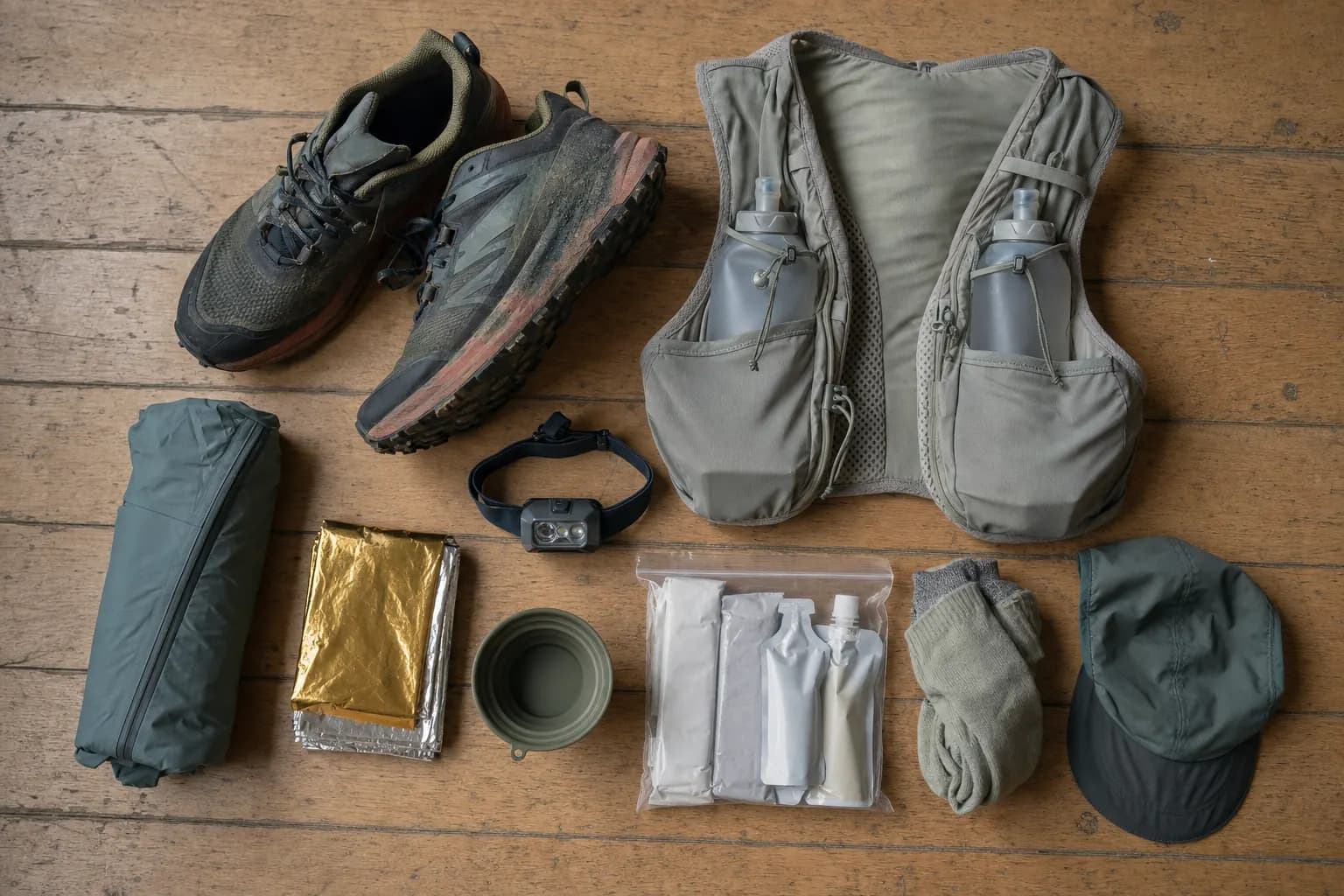
Running shoes. For the road, your trusted marathon shoes often work, with a bit more cushioning and room; your feet swell over long distances. For trails, you want grip and protection from rocks. How to choose running shoes explains what to look for.Vest or belt. A hydration vest with soft flasks carries water, food, and mandatory gear without bouncing. For a road ultra with frequent aid stations, a belt is sometimes enough. Try it on with full flasks.Headlamp. If you might finish after sunset, or start in the dark, you need a headlamp, plus spare batteries. In a 100-mile race, you'll almost certainly run through the night, so practice in the dark a few times too.Mandatory gear. Many trail races require items like a phone, an emergency blanket, your own cup, a rain jacket, and a minimum amount of water. Read the rules carefully and train with the weight you'll actually carry.The small stuff. Socks that don't rub, anti-chafe balm, and sunglasses or a cap. For more ideas, see the best running accessories.
The longer you're out there, the more your core and hips need to hold your form. Fifteen minutes of core and stability exercises two or three times a week helps you keep good form for longer, especially on uneven ground. Combining running and strength training shows how to fit it in.
After the race, give your body plenty of time. Plan on one or two truly easy weeks after a 50K, and several weeks after a 100K or 100-mile race before you train hard again. Sleep, food, and walking help more than a quick first run.
In the personal training plan wizard, choose Custom as the distance and enter your race distance, up to 200 km (124 miles). Anything beyond the marathon is treated as an ultra. Also read what's new for ultras.
Your distance matters. A 100-mile race gets a different plan than a 50K. The longer your race, the higher the weekly volume for advanced and experienced runners: at the peak, about 65 km40.4 mi to 80 km49.7 mi a week for a 50K and 85 km52.8 mi to 110 km68.4 mi for a 100-mile race. Plan on 16 to 24 weeks of preparation.Time on your feet. Your long run is listed in hours and minutes, with the distance as an estimate. For advanced and experienced runners, it grows to about 3 hours 15 minutes to 3 hours 30 minutes for a 50K and 4 hours 15 minutes to 4 hours 30 minutes for a 100-mile race.Back-to-backs. Advanced and experienced runners who run five or more days a week get a back-to-back about once every four weeks, the day after the long run. For a 100K or longer, that becomes once every three weeks in the last eight weeks. You need two running days in a row for that; if that day is missing, the wizard suggests adding it.Surface and elevation gain. For an ultra, the wizard asks right away about the surface (road or trail) and the elevation gain. On trails or with a lot of climbing, you get workouts with power hiking, and your plan guides you by effort instead of pace.A realistic finish time. You see your expected finish time as a range. If you enter a goal time, you'll see whether it's realistic. If you enter the cutoff time, you'll see whether your expected time fits comfortably, tightly, or not at all.Workouts that fit an ultra. Depending on your level and your race: threshold blocks of 5 to 15 minutes, short strides, and on the road, in the last buildup weeks, a long run that finishes at your expected race pace. Tips on your long runs help you practice your fueling.Taper and tune-up race. Your plan tapers over the last two weeks, or the last three for a 100-mile race. For a 100K or longer, the week explanation suggests a marathon or 50K as a dress rehearsal, about 6 to 10 weeks before your ultra.
If your current weekly volume is still low for the distance you choose, the wizard tells you so honestly, with a suggestion. Your plan is ready either way.
It isn't required, but it's wise. A marathon teaches you how your body handles a long effort, fueling on the go, and the final hours. For a 100K or 100-mile race, that experience matters even more.
Plan on about 16 to 24 weeks of specific preparation, on top of a base of months of consistent running. The longer and harder the race, the longer the buildup.
Just over three hours is enough; you don't need to run the race distance in training. A back-to-back with a second, shorter run the next day also teaches you to run on tired legs.
No. Almost everyone walks in an ultra, especially on steep climbs. Brisk walking there is often just as fast as running and costs less energy. Do train it, so you do it efficiently.
Many guidelines recommend 30 to 60 grams of carbohydrate per hour, and with a trained gut, it can approach 90 grams. Start in the first hour, take something every 30 minutes, and practice your race plan on your long runs.
Not for an ultra on the road or on wide, paved paths. For a trail with loose rocks, mud, or steep descents, yes: trail shoes give you grip and protection. Break them in before race day.
Two long, easy runs on two days in a row, for example three hours on Saturday and two hours on Sunday. It trains you to run on tired legs without one extremely long session.