October 10, 2026
Our new plan engine: a running plan that fits you better
A build-up that starts from what you run today, workouts that match your level and goal, better safeguards in the plan builder, and new types of training. Find out what happens to your existing plan.
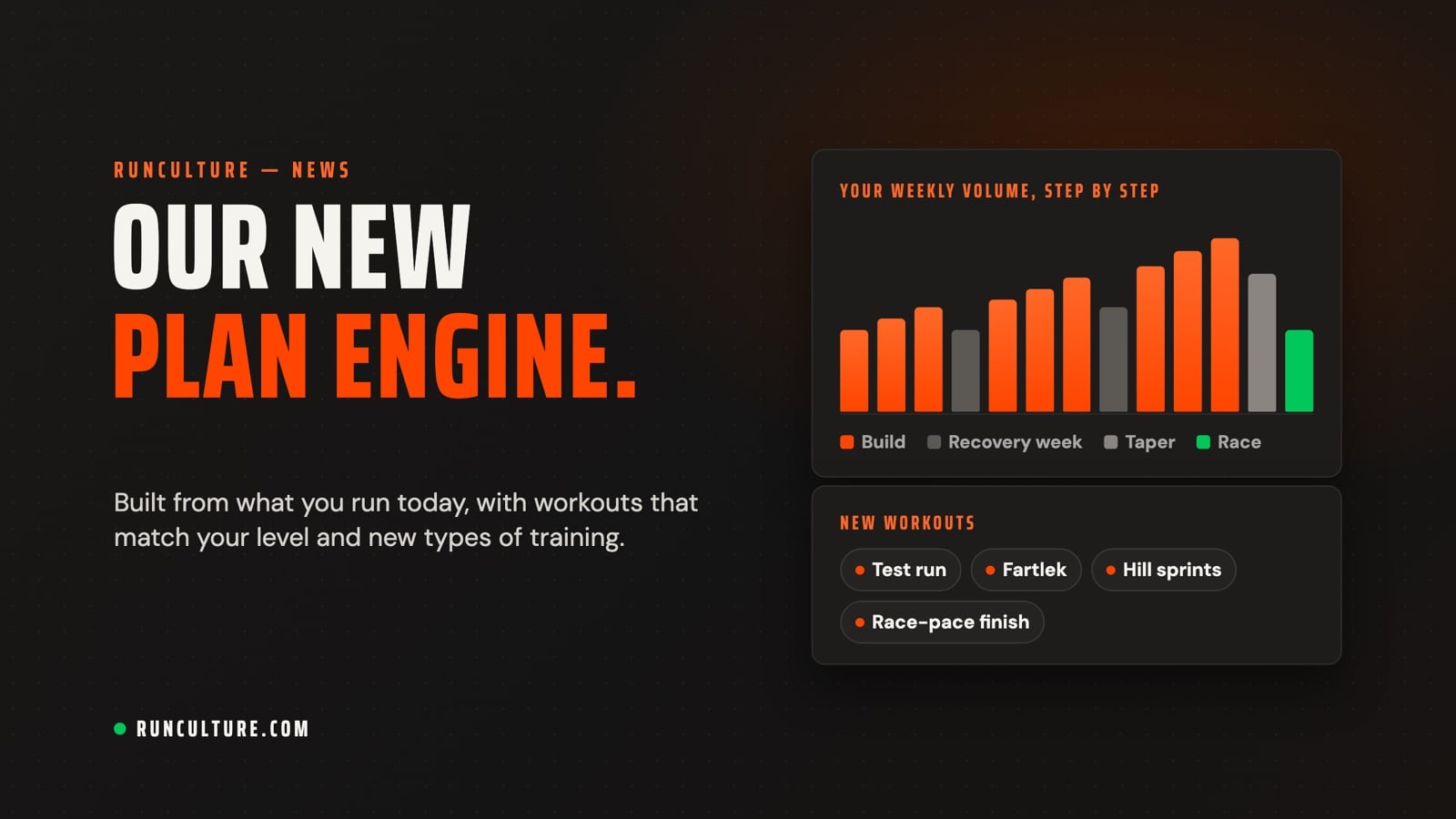
Good news! Over the past few months, we've been working hard behind the scenes on one thing: helping you run even better. We talked with running coaches, read all of your feedback, and used it to build a completely new plan engine. Starting today, it calculates your running plan.
The new engine looks more closely at what you already run, picks workouts that match your level and goal, and lets your paces grow with your fitness. We're also recalculating existing plans. If you've already started working with your plan, it stays exactly as it is. You'll find what that means for you at the end of this article.
At a glance:
Weekly volume that starts from what you run today
This might be the part we're proudest of. The foundation of any plan is how much you run each week. The new engine builds that up from your situation: your current weekly volume, your longest run in recent weeks, and the number of days you want to train.
We determine your level from your weekly volume, the number of runs per week, and your longest run:
| Level | Weekly volume | Also |
|---|---|---|
| New runner | less than 5 km3.1 mi | or not yet 30 minutes without stopping |
| Beginner | 5 km3.1 mi to 15 km9.3 mi | |
| Recreational | 15 km9.3 mi to 30 km18.6 mi | at least 2 runs a week |
| Advanced | 30 km18.6 mi to 50 km31.1 mi | at least 3 runs, longest run of 10 km6.2 mi or more |
| Experienced | 50 km31.1 mi or more | at least 4 runs, longest run of 16 km9.9 mi or more |
Workouts that match your level and goal
Not everyone needs the same workouts. Each week, the new engine picks what suits your level, your goal, and your number of training days.
Better safeguards in the plan builder
When you create your plan, the plan builder keeps an eye on things. It never blocks you, but it tells you honestly when your plan asks too much.
New workouts in your plan
And now for the fun part: more variety in your plan! The new engine includes types of training your plan didn't have before. These are the highlights.
TuesdayExample
Easy run
5 min walk
30 min by feel
A test run after the run-walk block
Starting with a run-walk starter block? At the end of it, you run your first 30 minutes without stopping. That run is your test run: keep it truly easy, and afterward enter in your feedback how far you got and how it felt. We use that to calculate paces for the weeks ahead. Until then, you run by feel. If the test run doesn't work out, you can redo it later during an easy run of 20 to 40 minutes without stopping. You need an account to enter your result.
TuesdayExample
Fartlek workout
10 min warm-up
Repeat 5x:
3 min brisk
1:30 min jog
4 min cool-down
Fartlek, by feel
In a fartlek, you alternate easy running with brisk stretches, without checking your watch. That's why the card shows no pace; you'll find a guideline in the tip. The light version is an easy run with a few brisk stretches that helps you get used to running faster. The full fartlek is a proper quality workout.
WednesdayExample
Hill repeats
10 min @ 6:10 min / km9:50 min / mi
Repeat 8x:
1 min at 5K effort
1 min jog @ 6:10 min / km9:50 min / mi
5 min @ 6:10 min / km9:50 min / mi
Hill training, if you want it
Have a hill or slope nearby? Then turn on Include hill sprints and hill repeats under Advanced options. You'll get short uphill sprints during an easy run and sometimes a workout of uphill repeats. Hill training starts at the recreational level; the option only appears if your plan will actually include hill workouts. You'll also find it under Edit plan.
MondayExample
Short sharpening workout
10 min @ 6:00 min / km9:35 min / mi
Repeat 5x:
2:30 min @ 4:45 min / km7:40 min / mi
2:30 min jog @ 6:00 min / km9:35 min / mi
3 min @ 6:00 min / km9:35 min / mi
Sharp on race day
During your taper, you get one short sharpening workout with much less work than in your hardest weeks. In race week, a few days before your race, you do an easy run with a few short pickups. That keeps your legs sharp without tiring you out. You get these sessions from the recreational level up.
SaturdayExample
Long run +
Run: 107 min @ 5:45 min / km9:15 min / mi
Last 2 km at race paceLast 1.2 mi at race pace @ 4:45 min / km7:40 min / mi
Long run with a fast finish
If you're training for a longer distance, such as a half marathon or marathon, you'll sometimes run the last part of your long run at marathon pace or race pace. That way, you practice holding your pace on tired legs.
MondayExample
Half marathon pace run
10 min @ 6:05 min / km9:45 min / mi
Repeat 3x:
1.5 km0.9 mi @ 4:45 min / km7:40 min / mi
2:30 min jog @ 6:05 min / km9:45 min / mi
3 min @ 6:05 min / km9:45 min / mi
At your own race pace
In the final weeks before your race, you'll train more often at the pace of your own distance, from 3K pace to half marathon pace.
What happens to your existing plan
We're converting existing plans to the new engine, except plans you've already started working with (see below). A converted plan stays, with the same link and the same settings: your goal, your training days, and your load. Only the workouts are recalculated. For a plan that's in progress or hasn't started yet, your race date and the number of weeks stay the same.
Already checked off, edited, or moved workouts, or added feedback? Then we leave your plan exactly as it is, with all your check-offs, changes, and feedback. You just keep training with the plan you know.
Make changes without losing the weeks you've run
After the conversion, you can adjust your plan just as before. If you change your settings later, for example by adding a training day or choosing a different target time, the weeks you've already run stay as they are. Only the rest of your plan is recalculated, starting from the current week. Checking off workouts doesn't change your plan.
Did we leave your plan unchanged because you were already working with it, and do you change your settings later? Then we'll recreate your plan with the new engine. You'll be asked to confirm first, because your check-offs and feedback will be cleared.
Curious what your plan looks like now? Open your plans or create a new plan at runculture.com/plan/personal.
We'd love to hear what you think: your feedback helped shape this version, and it will keep doing so. Happy running!