October 20, 2026
Extra races in your plan: train for the race in front of you
Running a 10K or a half marathon on the way to your goal? Add up to three extra races to your plan. You always train for the next race, with lighter days before it, recovery after it, and an expected finish time for each race.
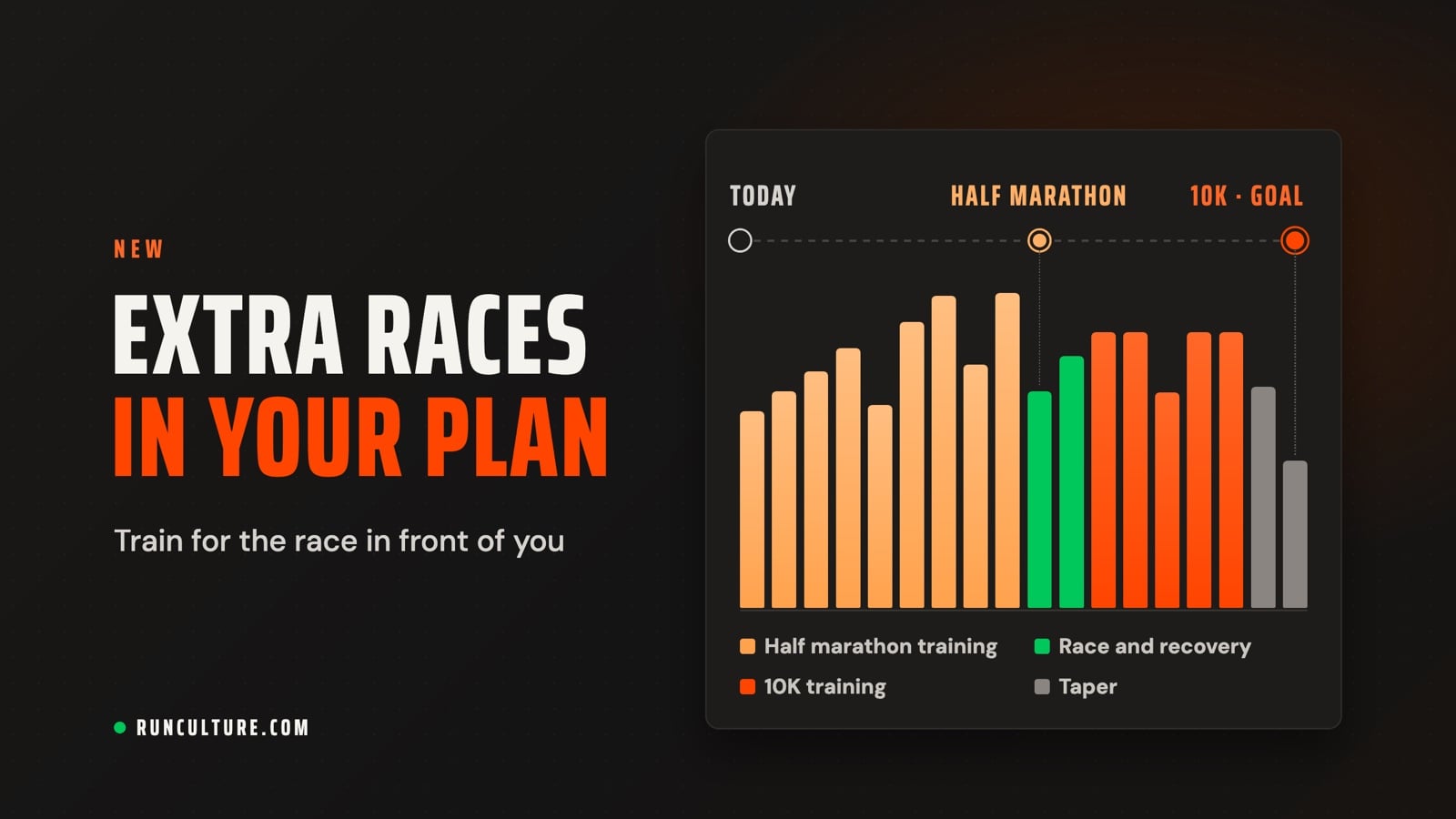
Few runners train for months toward one race without running another one along the way. A 10K in the winter, a half marathon as a dress rehearsal, or simply the local race in your own town: they're all part of running. Starting today, your plan takes them into account. Add up to three extra races before your goal, and your plan builds them in, with a lighter week before each race, recovery after it, and an expected finish time for every race.
At a glance:
The principle: you always train for the next race on your calendar. How your plan unfolds: an example with a half marathon on the way to a 10K. Around every race: a lighter week before and easy days after, based on the distance. Your result counts: enter your time and your paces grow with you. How to add a race: in the plan builder or in a plan you've already started.
Train for the race in front of you
Coaches follow a simple principle: train for the race in front of you. What you train this week depends on the next race on your calendar, not only on your final goal. RunCulture now follows that principle too.
One build-up, one goal. Your plan builds toward your final goal and goal time. An extra race is a step along the way: it doesn't get its own goal time, but a realistic expected time. Your workouts follow the next race. In the weeks before a half marathon, you get half marathon training, with longer long runs and threshold workouts. After the race, your plan shifts to training for your goal. Before a 5K, you get more short, fast workouts instead. Your volume follows the race, too. Your long run and weekly volume build toward the longest race still ahead. If you run a marathon first and a 5K after that, the first part is marathon training and the second part is 5K training, with less volume. The order doesn't matter. Every race gets the same treatment. What changes comes from the distance.
How your plan unfolds: an example
A recreational runner currently runs about 30 km18.6 mi a week, trains 4 days a week, and wants to run a 10K in 18 weeks. There's a half marathon in week 10. Here's what the plan looks like:
| Weeks | What you train | Long run |
|---|---|---|
| 1–4 | General build-up, with threshold work and short pickups | builds from 13 km8.1 mi to 18 km11.2 mi |
| 5–9 | Half marathon training, with recovery weeks in weeks 5 and 8 | up to 19 km11.8 mi |
| 10 | Race week: fewer miles, half marathon on Sunday | the race itself |
| 11 | Recovery: 2 days off, then easy runs only | none |
| 12–16 | 10K training, with a recovery week in week 14 | back to 13 km8.1 mi |
| 17–18 | Taper and race week, your 10K on Sunday | 9 km5.6 mi, then the race |
You can see the principle at work. Until the half marathon, your long run builds to a length that fits that distance. After the race, it drops back to what you need for a 10K, and the focus shifts to speed. Race week counts as a recovery week, so you don't lose a build-up week.
Easier before, recovery after
How your plan handles an extra race depends on the distance.
3K through 10K: a mini taper. Your race week has about 20% fewer miles. You do your last quality workout no later than four days before the race, and only easy runs after that. 15K and half marathon: a light race week. Fewer miles, at most one short, light workout, and rest or a short shakeout run the day before. 30K, marathon, and longer: a full taper. After the race, your volume comes back over two weeks: first 70%, then 85%, and then back to normal. Close to your goal, your goal comes first. If a long race falls in the final weeks before your goal race, it doesn't get its own taper. You run it as a training run, so your preparation for your goal stays intact.
After every race, you get easy days: easy runs only, no quality workouts, and no long run. The first days, you don't run at all.
| Race | Easy days | Of which no running |
|---|---|---|
| 5K | 2 | 1 |
| 10K | 4 | 2 |
| Half marathon | 7 | 2 |
| Marathon | 14 | 2 |
For each race, you'll see an expected finish time and the matching pace, in the race tip and on the pace band. That time is based on your fitness in that week: the further along you are in your plan, the faster it gets.
Your result counts
After the race, enter your result on the race in your plan: your distance, your time, and how hard it felt. Your result counts as a fitness check, just like a test run.
Did you run all out? Then your time counts in full. Starting the next day, your paces are based on your result, and you'll see what we expect for your goal race. Faster than your goal requires? Then we'll suggest a faster goal time. Your goal time only changes if you choose to. Slower than expected? One race doesn't tell the whole story, so your paces stay as they are. If you'd still like to change them, choose Adjust paces. Partly done? Then you don't have to enter a time, and the race won't count toward your paces.
You need an account to enter your result.
How to add a race
In a new plan. In step 1 of the plan builder, choose a race or a PR as your goal. Below it, you'll see the timeline from today to your goal. Choose Add a tune-up race, then find your race in the race calendar or enter it yourself. Each race moves into place on the timeline, and you can see how many weeks there are between your races.
In a plan you've already started. Open the Adjust menu in your plan and choose Add a race. Days that have already passed stay exactly as they were. Your plan only recalculates from today.
Good to know:
You can add up to three extra races, all before your goal. Extra races work with a goal that has a distance: a race or a PR. They aren't available for fitness or recovery plans, or for the standard plans. If your races cost build-up weeks, the plan builder tells you how many. If a long race comes too soon after you start, you'll see a recommendation, but you can still add it. Sharing your plan with others? They only see your extra races as, for example, "Race · 10 km6.2 mi", without the name.
Running another race this season? Create your plan or add the race to the plan you've already started.