01 · Why posture mattersWhy running posture is important
Partway through a run, you notice your shoulders creeping up or catch yourself trying to take ever longer steps. These are useful moments to pay attention to your running form. Start small: relax your hands, let your shoulders drop, and keep going at the same easy pace.
Your posture, arm swing, and foot placement work together. An adjustment can change how the load is distributed through your body, but a stride that looks neater is not automatically more economical or injury-free. Your build, pace, experience, and fatigue matter too. There is no single version of proper running form that every runner needs to copy.
This guide explains what to look for and how to practice without constantly checking your entire body. If your goal is to get faster, how you build your training still matters. Read more about improving your running speed.
02 · Efficient posture basicsBasic principles for an efficient posture
Body position
Arm swing
Foot landing
Core stability
Body position
Think about standing tall without stretching yourself upward. Keep your head roughly above your torso and look ahead so you can see the surface and other people in time. You do not need to push your chest out or squeeze your shoulder blades together.
A slight forward lean may emerge naturally as you run. The cue “from your ankles” mainly helps you avoid folding forward at the waist. Do not force a particular angle or try to fall forward: your posture changes with your pace and the slope of the road.
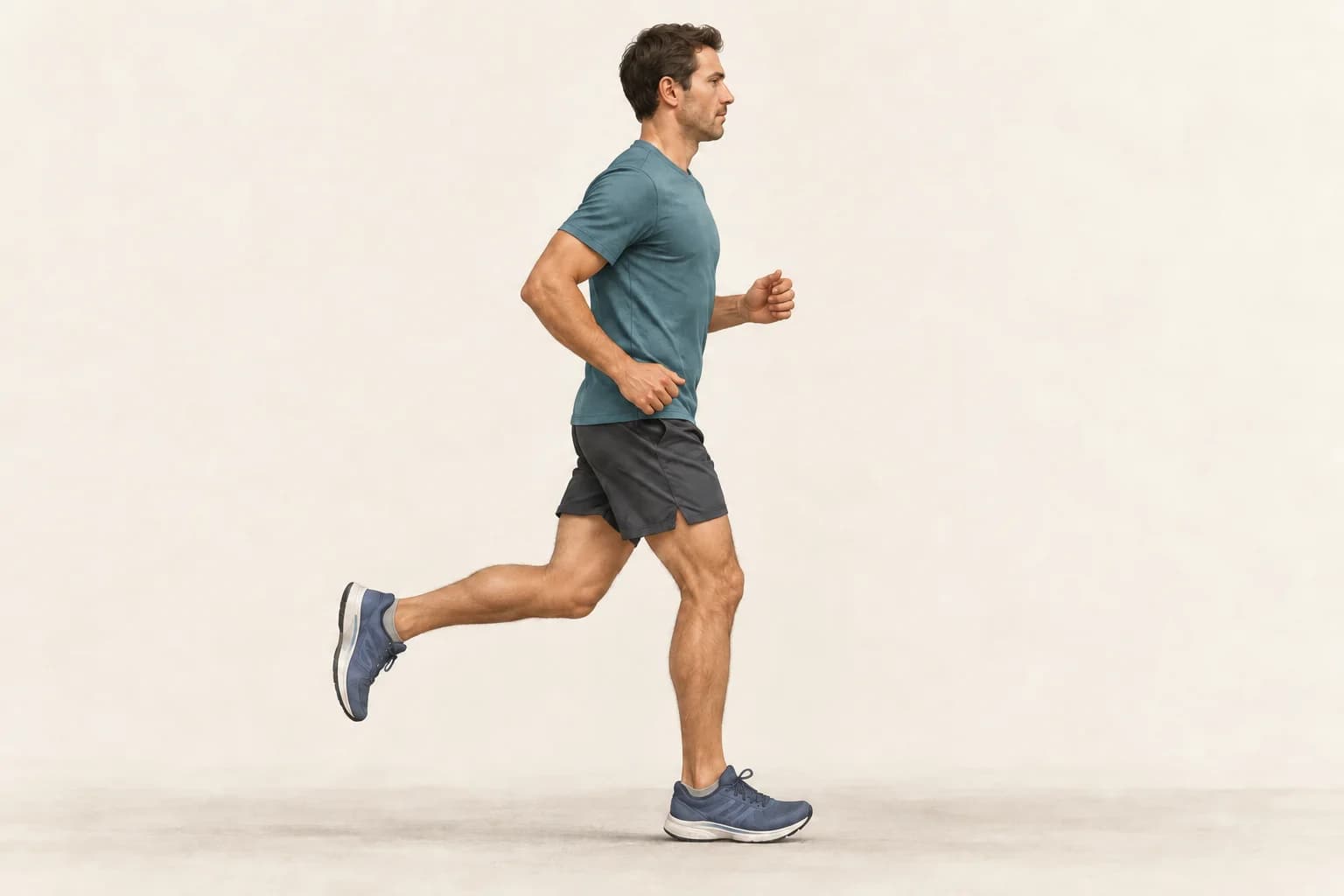
Notice the continuous line of the head and torso. This is a visual cue, not a fixed angle to reproduce on every step.
Arm swing
Your arms help counter the rotational movement of your legs. Let them move freely. You do not need to swing harder deliberately to drive your legs, and holding your arms still is not the aim either.

The elbows stay bent while the movement comes from the shoulders. Keep the arm swing comfortable for your pace rather than making it as large as possible.
Your cadence is the total number of steps per minute, counting both feet. There is no compulsory target of 180 steps per minute; your natural rhythm depends partly on your pace and build. A slightly higher cadence at the same speed means shorter steps. That can be worth exploring if you reach too far forward, but higher is not automatically better.
Foot landing
Should you land on your heel, midfoot, or forefoot? An uninjured runner does not need to switch to a midfoot or forefoot strike simply to achieve “better” technique. A different strike pattern shifts the load: landing farther forward on the foot, for example, asks more of the ankle and calf region. It does not guarantee fewer injuries or lower energy use.
Look at the whole step first. When you overstride, you reach unnecessarily far forward. Heel striking and overstriding are not the same thing: you can also land too far ahead on your forefoot.
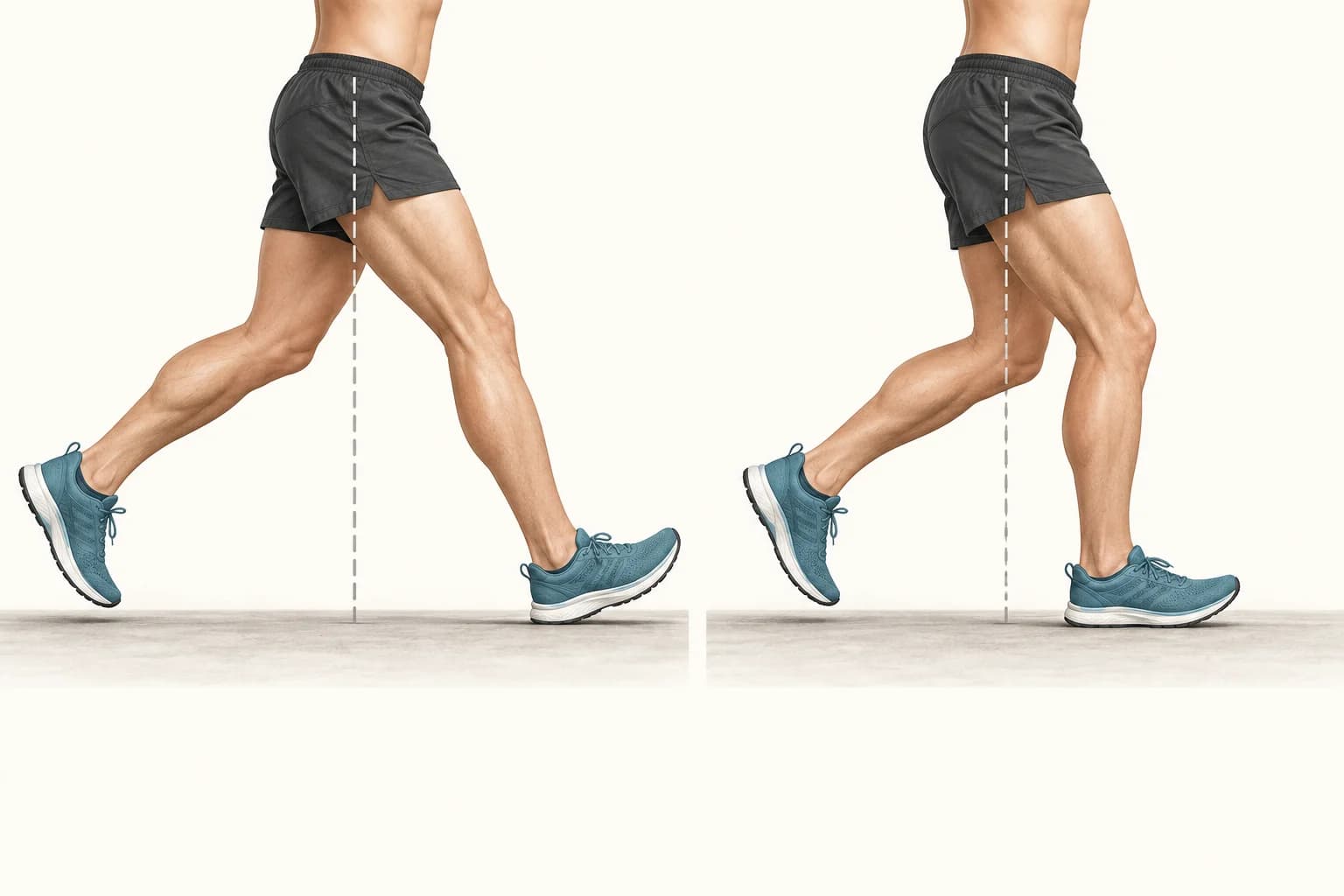
The leg reaches farther forward on the left; the step is more compact on the right. The dotted line is a schematic reference to the hip, not a measurement of your center of mass. Both feet land ahead of it. This image compares reach rather than identifying an ideal heel, midfoot, or forefoot strike.
Choose shoes mainly for a comfortable fit and the running you plan to do. The guide to types of running shoes can help with that choice; a shoe is not a reason to force a particular foot strike.
Core stability
Here, your core means the muscles around your torso and pelvis. You can practice controlling this area separately. That does not mean pulling your stomach in as you run or keeping your hips completely still: some movement is part of running.
For example, try a short sequence twice a week when you are not exhausted:
These are starting examples, not a fitness test. Keep breathing and reduce the movement if you lose control. Core exercises alone do not guarantee fewer injuries or a longer stride. For ideas on fitting strength work into your week, see combining running and strength training.
03 · Helpful drillsTechnique drills that help
Running drills are short exercises that let you explore a movement deliberately. You do not need to do them all, and they do not replace your regular running. After five to ten minutes of easy movement, begin with one or two familiar exercises. The warm-up and cool-down guide offers more examples of a gradual start.
A small selection to practice
04 · Posture and effectPostural elements and their effect
These elements help you look at your form with a specific question in mind. Use the table to choose one focus rather than trying to control your entire running style at once.
| Element | What to look for | Common pitfall |
|---|---|---|
| Body position | Running tall and relaxed with a view of your route | Forcing a fixed lean or bending forward at the waist |
| Arm swing | Natural movement that suits your pace | Making fists and raising your shoulders |
| Foot landing | Avoiding unnecessary reaching forward | Forcing a midfoot strike or landing exactly beneath the hip |
| Core stability | Practicing control without blocking all movement | Bracing your stomach hard throughout the run |
Changing your step length also changes your cadence if you keep the same pace. That is a reason to try small adjustments separately rather than changing everything together.
05 · Improve posture in practiceHow do you improve your running posture in practice?
Choose one cue for your next easy run, such as “loose hands.” After warming up, practice it three times for thirty seconds, with at least a minute of normal running between efforts. Notice whether it stays comfortable and whether you speed up without meaning to. This is a simple practice example, not a proven optimal dose.
06 · MistakesCommon mistakes
Technique practice becomes difficult when every step feels like a checklist. These pitfalls are usually straightforward to recognize:
If you run comfortably without symptoms, you do not need to keep correcting your technique. Choose a change because it addresses a specific question, not because a video promises one universally ideal stride.